For most of the deep-learning era, "better" meant "bigger": more parameters, more data, more training compute. The reasoning-model wave changed the axis we scale on. Instead of only spending compute during training, we now spend it at inference — letting the model generate, deliberate, and revise before it answers.
Thinking as a resource
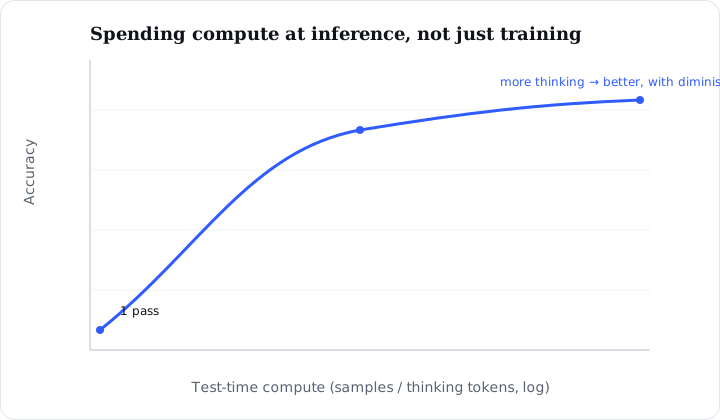
A reasoning model produces a long internal chain of thought before its final answer. That chain costs tokens — and tokens cost compute — but on hard problems (math, code, multi-step logic) the extra deliberation buys real accuracy. The striking empirical result: quality scales smoothly with how long you let the model think, much as it once scaled with model size.
The lesson is not "chains of thought are magic." It's that search — proposing, checking, and backtracking — is a lever we had barely pulled at inference time.
Why it works
Three ingredients matter:
- Verification. A model that can check a candidate answer can afford to generate many and keep the best.
- Reinforcement on outcomes. Training the policy against a reward for correct final answers (not imitation of a single reference) teaches genuinely useful reasoning strategies.
- Sampling. More attempts, aggregated well, beat a single greedy pass.
The cost curve
Test-time compute is not free. Latency and price rise with thinking length, and returns diminish — the curve bends. The engineering question of 2026 is no longer "can it reason?" but "how much thinking is worth it for this request?" Routing easy queries to short answers and hard ones to long deliberation is where the money and the user experience are won.
What to watch
Expect the frontier to move toward adaptive reasoning — models that decide for themselves how long to think — and toward cheaper verification, since a good verifier multiplies the value of every sampled attempt.