Embeddings are one of the most useful ideas in modern AI, and one of the least understood outside the field. At heart, an embedding turns something — a word, a sentence, an image — into a list of numbers that captures its meaning.
Meaning as location
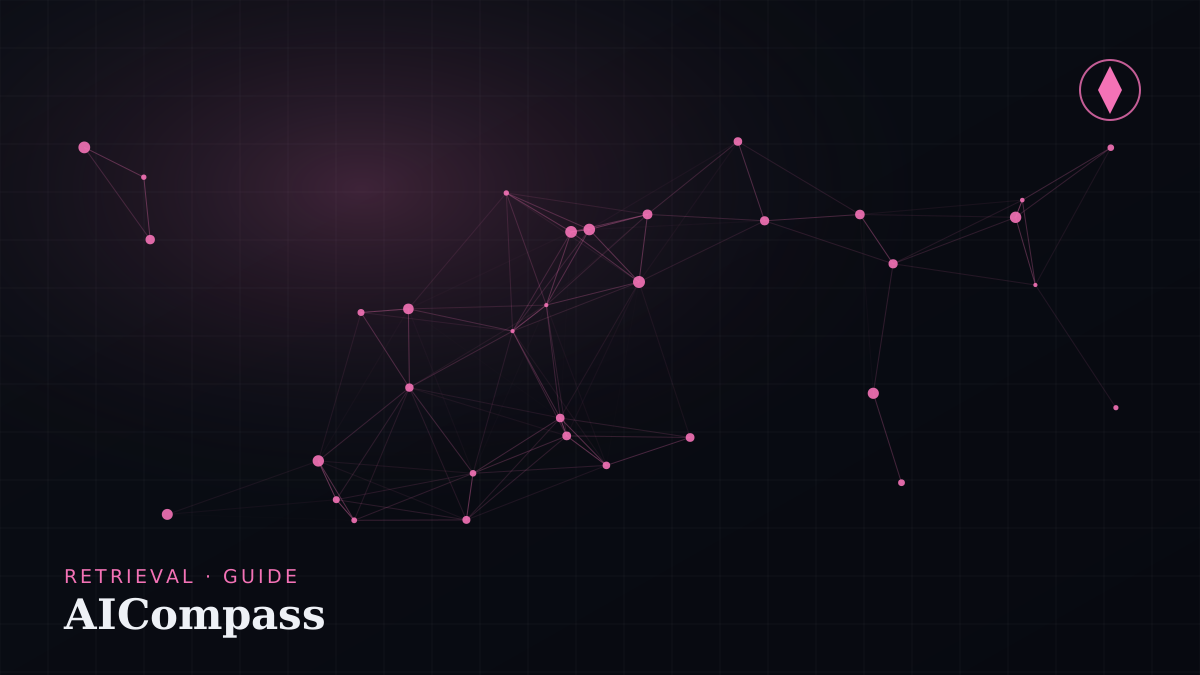
The trick is that these numbers place each item as a point in a high-dimensional space, arranged so that similar things sit close together. "Dog" and "puppy" land near each other; "dog" and "spreadsheet" land far apart. The distance between two embeddings measures how related their meanings are. Suddenly, "find similar things" becomes "find nearby points" — a math problem computers are great at.
An embedding is a coordinate for meaning. Once ideas have coordinates, you can measure how close they are.
What they power
This unlocks a huge amount:
- Semantic search — find documents by meaning, not just keyword match.
- RAG — retrieve relevant context for a language model by embedding the question and finding nearby chunks.
- Recommendations — suggest items near what you liked.
- Clustering & classification — group similar things automatically.
Why they matter now
Embeddings are the bridge between raw content and everything you want to do with it. Every RAG system, every vector database, every "find similar" feature runs on them. Modern embedding models are small, fast, and multilingual — and increasingly multimodal, placing text and images in the same space so you can search images with words. If you're building anything that needs to understand similarity or meaning, embeddings are where it starts.